

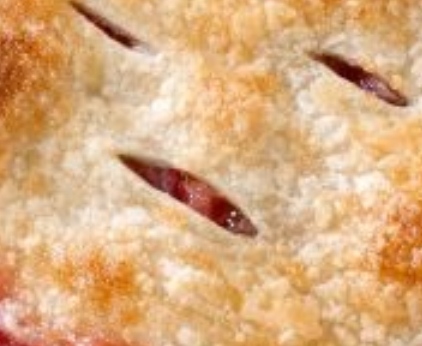
This humble 4-ingredient rhubarb pie is the kind of dessert that saw families through hard times and still feels like a celebration. My Great Grandma Rose called it her “garden secret” because everything but the sugar came from right outside the farmhouse door. Fresh rhubarb, a simple sprinkle of sugar and flour, and a plain pie crust were all she needed to turn lean years into something sweet and comforting. There’s nothing fancy here, just the old Midwestern way of baking: practical, frugal, and full of love. One bite of that tangy-sweet pink filling under a golden crust takes me straight back to her cozy kitchen, with the windows cracked open to let in the spring air and the smell of rhubarb bubbling away in the oven.
Serve this rhubarb pie slightly warm or at room temperature so the juices have time to thicken. A scoop of vanilla ice cream or a spoonful of lightly sweetened whipped cream is lovely, but not required—Grandma often served it plain with a cup of hot coffee. It makes a fine ending to a simple supper of meatloaf and mashed potatoes, or as the star of a Sunday afternoon coffee break. If you’re lucky enough to have leftovers, enjoy a cold slice for breakfast with a glass of milk, just the way farm folks have done for generations.
4-Ingredient Depression Era Rhubarb Pie
Servings: 8
Ingredients
4 cups fresh rhubarb, sliced 1/2-inch thick (about 1 to 1 1/4 pounds, trimmed)
1 1/3 cups granulated sugar
1/3 cup all-purpose flour
1 (9-inch) double pie crust (bottom crust plus top crust), homemade or store-bought
Directions
Preheat your oven to 425°F (220°C). Place a rack in the lower third of the oven to help the bottom crust bake through. Set a glass 9-inch pie plate on the counter.
If using homemade pastry, roll out your bottom crust into a circle about 12 inches across. Fit it into the glass pie plate, easing it into the corners without stretching. Let the extra dough hang over the edge. If using a boxed crust, follow the package directions to fit the bottom crust into the plate.
In a large mixing bowl, stir together the sugar and flour until no streaks of flour remain. This simple blend is what thickens the juices, just the way Grandma did it before anyone talked about cornstarch or fancy thickeners.
Add the sliced rhubarb to the sugar-flour mixture. Toss well with a spoon or your hands until every piece of rhubarb is coated and the sugar mixture looks evenly distributed. The rhubarb will start to look a bit damp as it pulls out some juice—that’s just right.
Spoon the rhubarb filling into the prepared bottom crust, scraping every bit of sugary flour from the bowl into the pie. Spread the filling into an even layer, mounding it slightly higher in the center so it bakes up nicely.
Roll out the top crust to about 11–12 inches across. Lay it gently over the rhubarb filling. Trim the edges of both crusts so you have about 1/2 inch of overhang all around the pie plate.
Fold the overhanging dough under itself all the way around the edge to seal the top and bottom crusts together. Crimp the edge with your fingers or press with a fork, just like Grandma would at the kitchen table.
Using a sharp knife, cut 4 to 6 small slits in the top crust to let steam escape. You can make a simple crisscross or a little star pattern—nothing fancy is needed, but the vents help the filling bubble without bursting the crust.
Place the pie on a foil-lined baking sheet to catch any drips. Slide it into the preheated oven on the lower rack. Bake at 425°F (220°C) for 15 minutes to set the crust.
After 15 minutes, reduce the oven temperature to 350°F (175°C) without opening the oven door if you can help it. Continue baking for another 35–45 minutes, or until the top crust is lightly browned and you can see the pink rhubarb juices bubbling up through the slits in the crust.
If the edges of the crust start to brown too quickly before the filling is bubbling, gently cover the edges with strips of foil or a pie shield and continue baking. The bubbling is your sign that the flour has thickened the juices properly.
When the crust is a light golden brown and the filling is visibly bubbling, remove the pie from the oven. Set the glass pie plate on a cooling rack or a folded kitchen towel on your light-colored counter and let it cool at least 2–3 hours. The filling will look quite juicy at first but will thicken as it cools, just like Grandma’s did.
Slice and serve the pie once it has mostly cooled and the filling has set. Use a sharp knife and a pie server to lift out generous wedges, admiring that rosy, bubbly rhubarb tucked under the browned crust.
Variations & Tips
To stay true to Great Grandma Rose’s hard-times kitchen, this pie keeps to four basic ingredients, but you can still make small, practical adjustments. If your rhubarb is very tart (early spring stalks often are), you can add up to 1/4 cup more sugar without changing the character of the pie. If your rhubarb is on the sweeter side or you prefer a tangier bite, you can cut the sugar back to 1 cup, though the filling will be more sharp, the way many farm families liked it. For a slightly firmer filling, especially if your rhubarb is very juicy, you can increase the flour to 1/2 cup; this will give you cleaner slices once cooled. A simple lattice crust instead of a solid top is also perfectly in keeping with old-fashioned pies and lets more steam escape, which can help the filling thicken a bit more. If you must bake ahead, this pie keeps well at cool room temperature for about a day; after that, cover and refrigerate. For food safety, don’t leave the pie sitting out for more than 24 hours, especially in warm weather, as the moist filling and flour can encourage spoilage. Always wash and trim rhubarb carefully, discarding any leaves, which are not safe to eat due to naturally occurring toxins. Use a glass or ceramic pie plate rather than metal if you can, as rhubarb is quite acidic and can react with some metal pans, giving an off flavor. Let the pie cool completely before covering or refrigerating so condensation doesn’t make the crust soggy. When reheating a slice, warm it in a low oven rather than the microwave to keep the crust flaky, just like it came out of that old farmhouse oven.